Okay, I'm genuinely excited about this. If you've ever sat staring at a terminal waiting for tsc to finish checking a massive React monorepo, you'll know that "build fatigue" is a very real thing for UX engineers. We want to iterate on components, not watch progress bars.
The release of the TypeScript 7.0 beta marks a massive shift in how we build frontend applications. Microsoft has essentially rewritten the compiler in Go, moving away from the self-hosted JavaScript model to embrace native code speed and shared-memory multithreading. The results? They're frankly staggering.
The 10x Reality Check
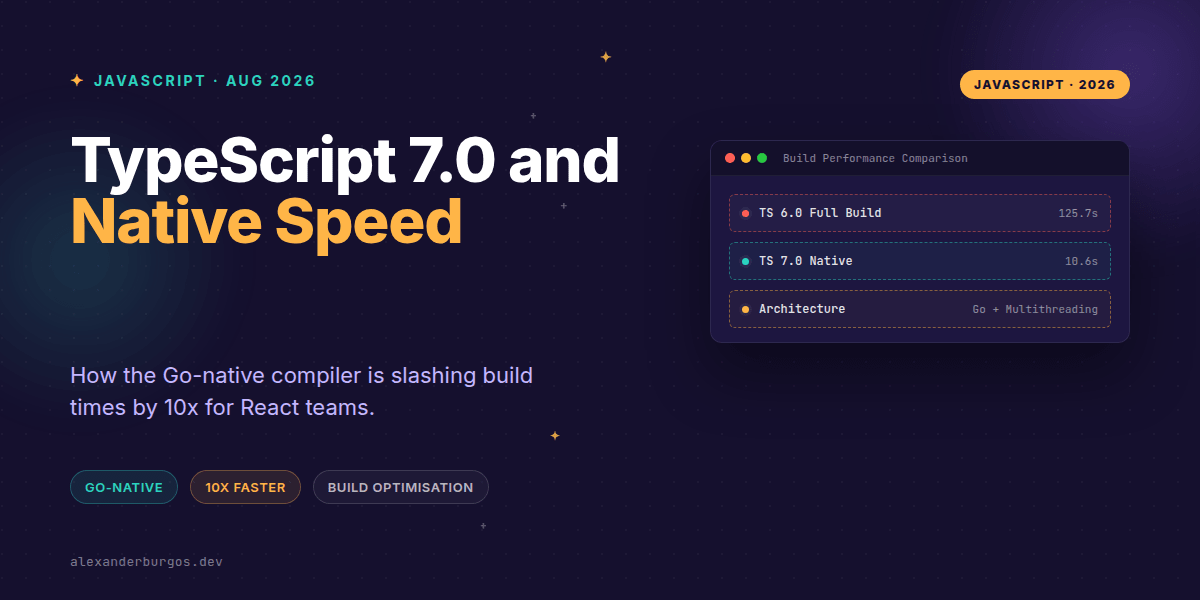
Microsoft’s official word is that TypeScript 7 is often about 10 times faster than TypeScript 6.0. While "10x" sounds like marketing hyperbole, the benchmark data they've shared across major open-source projects backs it up. We’re seeing full-build speedups typically landing between 8x and 12x.
- VS Code: Dropped from 125.7s to 10.6s (a massive 11.9x win).
- Sentry: Fell from 139.8s to 15.7s (8.9x faster).
- Playwright: Went from 12.8s to a mere 1.47s (8.7x faster).
For those of us managing design systems, these numbers aren't just statistics—they represent hours of reclaimed productivity every week. When your UI primitive library is used by fifty different apps in a monorepo, that type-checking overhead adds up quickly.
Why the Move to Go?
You might be wondering why Go was the choice. By moving to a native language, the compiler can take full advantage of shared-memory multithreading. The old JavaScript-based compiler was largely single-threaded, meaning it couldn't easily parallelise the complex work of type inference across your entire project.
In TypeScript 7.0, the compiler can saturate all your CPU cores. It's a fundamental architectural shift that addresses the biggest bottleneck in modern frontend development: the sheer size of our type graphs.
Migration Tactics for Design Systems
If you're ready to jump in, I'd suggest a cautious but systematic approach. Don't just flip the switch for the whole team on day one. Start by installing the native preview package in your devDependencies:
{
  "devDependencies": {
    "@typescript/native-preview": "beta"
  }
}
I've found that the best way to test this is to run the beta compiler in CI only on your largest package first. This allows you to compare wall-clock time and diagnostics against your stable TypeScript 6.0 baseline without breaking local developer environments.
Use the new native entrypoint to run your benchmarks. It’s a drop-in for tsc in most scenarios, but you'll want to verify your specific build scripts:
npx tsgo --project tsconfig.jsonOptimising Your TSConfig
While the Go compiler is faster, your tsconfig.json settings still matter. In large monorepos, you should still lean on these performance levers to get the most out of the new engine:
{
  "compilerOptions": {
    "incremental": true,
    "composite": true,
    "skipLibCheck": true
  }
}
Microsoft has noted that even without --incremental, TypeScript 7 often sees close to a 10x speedup on full builds. However, for the snappiest edit-refresh cycles in your design system's Storybook or documentation site, keeping incremental builds enabled is still a smart move.
Things to Watch Out For
It's not all magic and rainbows just yet. Remember, this is a beta. In my experience, the biggest risks aren't in the TypeScript syntax itself, but in the tooling ecosystem. Your IDE extensions, custom language service plugins, or complex CI wrappers might need an update to play nicely with the native binary.
Also, don't expect a flat 10x across the board. If you have a smaller project, the overhead of starting the native process might mean your absolute savings are less dramatic. The real wins are for the giants—the projects where a type-check used to mean a coffee break.
Wrapping Up
- TypeScript 7.0 uses a Go-native compiler to deliver massive 8x-12x speedups on full builds.
- Target your largest, most complex packages first for migration to see the biggest impact on CI times.
- Validate your tooling and IDE support before rolling out the beta to your entire engineering organisation.
I'd really encourage you to experiment with the beta on a branch this week. Even if you don't ship it to production immediately, seeing your build time drop from minutes to seconds is a glimpse into a much more pleasant future for frontend engineering.
If you want to go deeper and learn how to build real, production-ready CSS design systems step by step, check out my full course here: CSS Design Systems Course
The long version with support labels and runnable demos is in Modern CSS 2026 on Amazon Kindle.
For more tips on performance and design systems, let's connect over on Twitter or LinkedIn. I'd love to hear what kind of speedups you're seeing!