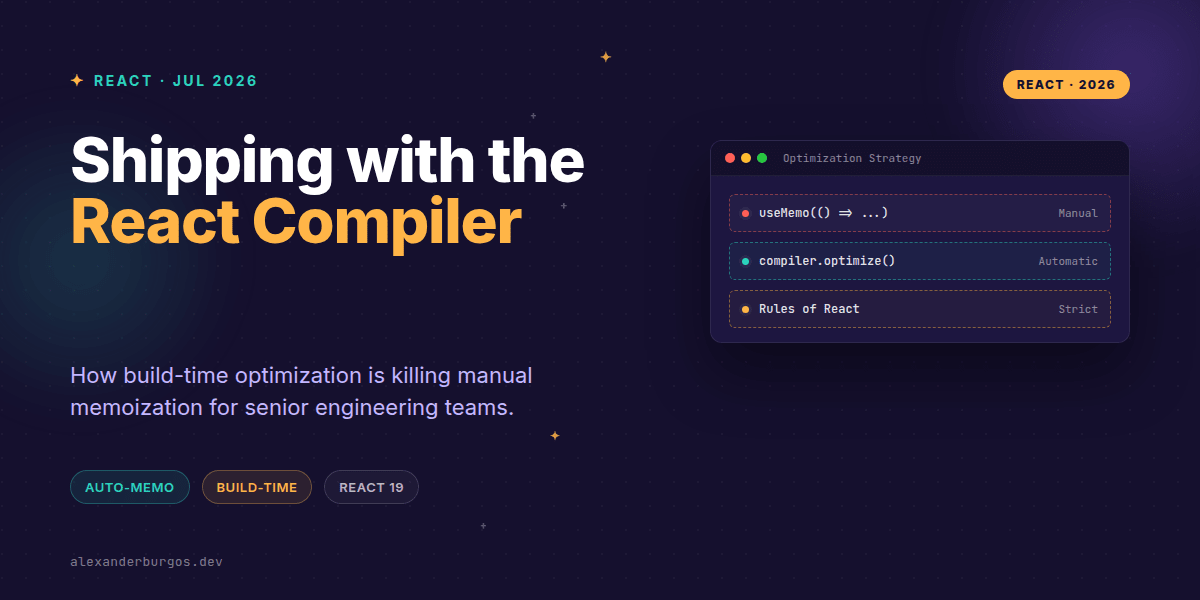
Okay, I'm genuinely excited about this. For years, we've been playing a game of 'spot the unnecessary re-render' with our React apps, peppering our codebases with useMemo and useCallback like some sort of performance-anxious confetti.
But following the v1.0 release in late 2025, the React Compiler has fundamentally shifted how my teams approach production workflows. It's no longer just an experimental tool powering Instagram; it's the standard for shipping high-performance React apps in 2026.
What does the Compiler actually do?
At its core, the React Compiler is a build-time tool that automatically optimizes your application. It hooks into your build pipeline—usually via a Babel or Vite plugin—and transforms your standard JavaScript into code where components, props, and hook dependencies are memoized by default.
I've found that the biggest mental shift is moving away from the 'performance API surface'. We used to spend hours debating whether a specific object literal should be wrapped in a hook. Now, the compiler handles that heavy lifting, letting us focus on the actual user experience.
The Death of Manual Memoization
In my experience, the most immediate change in a senior team's workflow is the deletion of boilerplate. We've spent a decade training developers to memorise the rules of dependency arrays. The compiler flips this on its head.
- Less React.memo: The compiler identifies which components benefit from memoization based on their prop usage.
- Automatic Stability: Functions and objects created inside components are automatically made stable if they don't depend on changing state.
- Semantic Focus: We can finally write 'clean' code without worrying about the performance tax of a new object reference.
However, don't mistake this for magic. The compiler is 'rules-aware'. If your code violates the fundamental Rules of React—like mutating props or calling hooks conditionally—the compiler will either skip those functions or throw errors via its companion ESLint plugin.
Integrating into the Build Pipeline
For those of us using Vite (which is most of us these days), enabling the compiler is surprisingly straightforward. It's a matter of updating your vite-plugin-react configuration to include the compiler as a Babel plugin.
// vite.config.js snippet
export default defineConfig({
  plugins: [react({
    babel: {
      plugins: [
        ['@react-compiler/babel-plugin', { /* options */ }]
      ]
    }
  })]
});
Once this is in place, your production build process changes. You're no longer just transpiling JSX; you're running a sophisticated optimization pass that converts your AST (Abstract Syntax Tree) into a highly efficient Intermediate Representation (IR) before spitting out the final JS.
New Profiling Habits
Our profiling habits have had to evolve. In the old days, we'd open the React DevTools Profiler and look for 'grey bars' (non-renders) vs 'coloured bars' (renders). We were obsessed with stopping re-renders.
Now, profiling in production is more about verifying Core Web Vitals. Since the compiler handles the micro-optimizations, we're free to look at the bigger picture: data-loading patterns, network bottlenecks, and layout shifts. We use the profiler to confirm the compiler is doing its job, but we spend far less time 'fixing' components that re-render too often.
Common Pitfalls to Watch Out For
I've seen a few teams fall into the trap of thinking the compiler replaces architectural thinking. It doesn't. If you have a massive, monolithic component that fetches data for ten different sub-trees, the compiler can't fix your data-fetching waterfall.
- Side Effects: Components with hidden side effects (like mutating global variables) will break the compiler's assumptions.
- Legacy Patterns: Old class-based components or non-compliant hooks won't see the same benefits.
- Verification: Always run Lighthouse audits. Compiler-generated code is efficient, but you still need to ensure your bundle size hasn't ballooned due to complex logic transformations.
Wrapping Up
- React Compiler is now a build-time essential that automates the 'performance tax' we used to pay manually.
- Senior teams should focus on code purity and strict adherence to React rules to get the most out of the optimization passes.
- Profiling has shifted from micro-management of re-renders to macro-monitoring of user-centric performance metrics.
I'd encourage you to try the compiler on a smaller feature branch first. See how much useMemo boilerplate you can actually delete—you might be surprised at how lean your components become.
If you want to go deeper and learn how to build real, production-ready CSS design systems step by step, check out my full course here: CSS Design Systems Course
I cover this and the other twenty-seven CSS shifts of 2026 in Modern CSS 2026 on Amazon, my catch-up book for people who learned CSS five years ago.
Let's chat about this over on Twitter or LinkedIn. I'd love to hear how your team is handling the transition to automated memoization!