Okay, I'm genuinely excited about this. While the React 19.3.1 release notes might look modest at first glance, the mention of an "improved transport protocol" is a massive signal for those of us building complex design systems and high-performance React apps.
We've all been there: you're trying to orchestrate a perfect loading sequence, but the handshake between the server and the client feels like a black box. With this latest update, the React team is refining the very pipes that deliver our UI. Let's dig into what this actually means for your day-to-day engineering.
The Heart of the Change: Transport Protocol
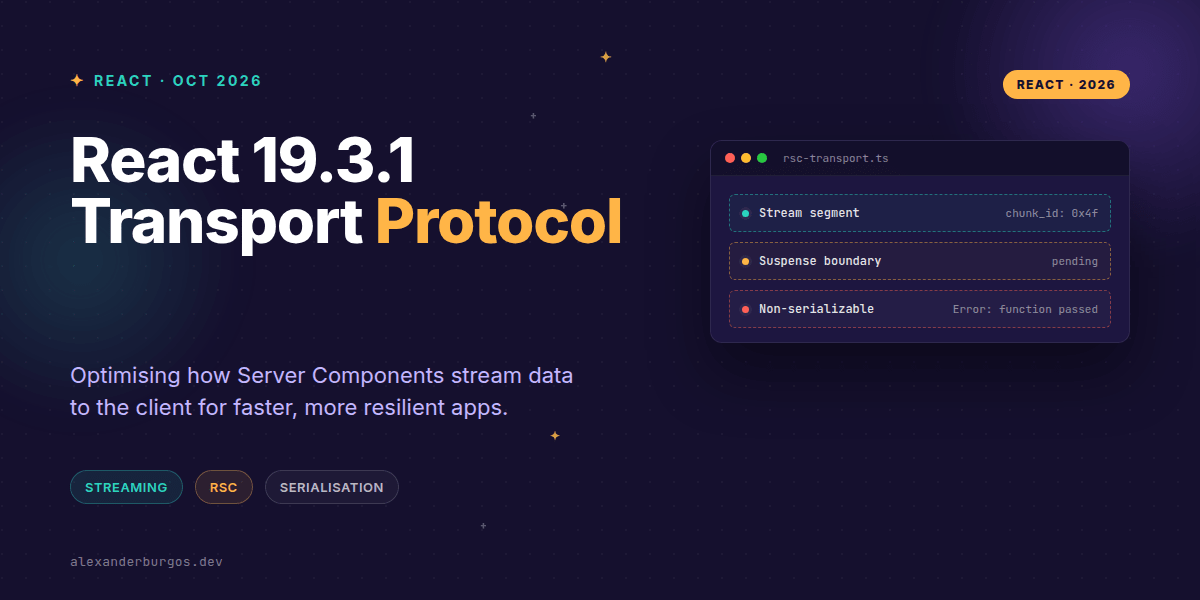
React 19.3.1 includes a specific improvement to the transport protocol (documented in PR #37845). In the world of React Server Components (RSC), the transport protocol is the wire format—the way React serialises your UI tree into a streamable data format that the browser can understand.
While we don't have a new public specification for every byte changed, the focus on protocol efficiency usually points toward better handling of references and markers. This is vital because, in an RSC architecture, the framework has to coordinate how native elements, client component placeholders, and props all travel across the network.
Mastering Streaming Boundaries
In my experience, the most powerful tool we have for controlling this transport is Suspense. It's not just a loading spinner; it's a marker that tells the transport protocol, "You can send the rest of the page now, and I'll send this bit later."
import { Suspense } from "react";

export default function Page() {
  return (
    <>
      <Header />
      <Suspense fallback={<ProductSkeleton />}>
        <ProductDetails />
      </Suspense>
    </>
  );
}
With the 19.3.1 improvements, the way these "pending segments" are encoded becomes more robust. When ProductDetails is ready, the server emits the data, and the transport protocol ensures the client knows exactly where to slot that new HTML without a full page re-render or layout shift.
Smart Caching and Error Resilience
One thing I've found that often trips up developers is how errors are handled in this new world. In React 19, the cache API is a game-changer for Server Components. It memoises function results—including errors—for the duration of a request.
import { cache } from "react";

const getProduct = cache(async (id: string) => {
  const response = await fetch(`/api/products/${id}`);
  if (!response.ok) throw new Error("Product unavailable");
  return response.json();
});
If the transport protocol encounters a cached error, it has to communicate that failure across the wire so the client-side Error Boundary can catch it. The 19.3.1 updates likely refine how these failure states are framed, ensuring that a transient network blip doesn't break your entire UI stream.
Design Systems and the Component Contract
As a UX Engineer, I'm constantly thinking about the contract between our components. When a component crosses the RSC boundary, its props must be serialisable. You can't pass a function (like an onClick handler) from a Server Component to a Client Component.
Instead, we pass data. The protocol improvement makes this hand-off more efficient, but the architectural rule remains: keep your logic in Client Components and your data fetching in Server Components.
// Server Component
import BuyButton from "./BuyButton";

export default function ProductCard({ product }) {
  // We pass the ID (serialisable), not a function
  return <BuyButton productId={product.id} />;
}

// Client Component
"use client";

export default function BuyButton({ productId }) {
  return <button onClick={() => addToCart(productId)}>Buy Now</button>;
}
This clear separation ensures that the transport protocol only carries what it needs to, keeping the initial payload light and the interaction snappy.
If you want the long-form version of this with 23 chapters and runnable code, Ship Your Design System on Amazon is the handbook.
Wrapping Up
- React 19.3.1 refines the transport protocol, making the serialisation of UI trees more efficient.
- Suspense remains your primary tool for defining streaming boundaries and managing the user experience during data fetching.
- Always ensure your props are serialisable when crossing from server to client to avoid transport errors.
Don't be afraid to experiment with these new boundaries in your local environment. Seeing how the stream chunks arrive in the network tab is the best way to truly understand how React 19.3.1 is changing the game.
If you want to go deeper and learn how to build real, production-ready CSS design systems step by step, check out my full course here: CSS Design Systems Course
Let's keep the conversation going! You can find me sharing more insights on Twitter or connect with me professionally on LinkedIn.