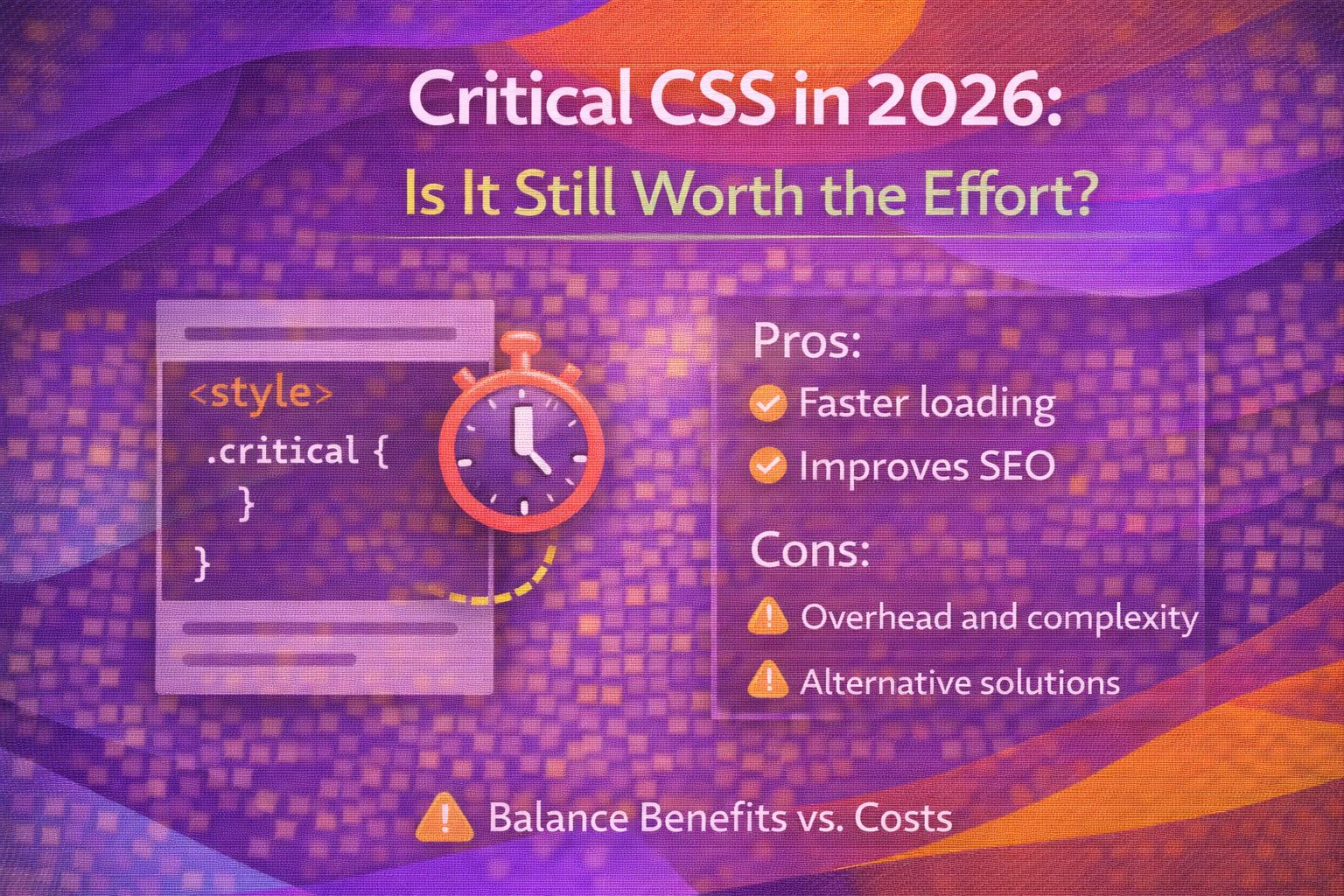
Let's be honest - Critical CSS has always felt like a bit of a chore. I've spent many late nights wrestling with build scripts just to shave a few milliseconds off the First Contentful Paint, and you might be wondering if it's still necessary in 2026.
The short answer? Absolutely. While our browsers have become incredibly smart, the fundamental way they render pages hasn't changed: external CSS is still a render-blocking resource.
The Anatomy of Critical CSS in 2026
The goal is to extract the styles required for the 'above-the-fold' content and inject them directly into the HTML document's head.
<!-- HTML Structure -->
<head>
  <meta charset="UTF-8">
  <title>Modern Performance</title>

  <style id="critical-css">
    /* Only styles for the header and hero section */
    .site-header { display: flex; justify-content: space-between; padding: 1rem; }
    .hero { background: var(--brand-bg); min-height: 80vh; padding: 4rem 2rem; }
    .hero__title { font-size: clamp(2rem, 8vw, 4rem); line-height: 1.1; }
  </style>
</head>
Once we've inlined the essential styles, we need a way to load the rest of our CSS without stopping the browser from showing the page to the user.
<!-- Loading non-critical CSS asynchronously -->
<link
  rel="preload"
  href="/assets/css/main.bundle.css"
  as="style"
  onload="this.rel='stylesheet'"
>

<noscript>
  <link rel="stylesheet" href="/assets/css/main.bundle.css">
</noscript>Leveraging Modern CSS to Shrink the Payload
The cool bit about 2026 is that features like CSS Nesting and Cascade Layers allow us to write much leaner styles, making our critical block smaller and more efficient.
/* Modern Nesting in Critical CSS */
@layer base, components;

@layer components {
  .hero {
    padding: 2rem;

    &__content {
      max-inline-size: 60ch;

      & h1 {
        color: canvasText;
      }
    }
  }
}
We can also use Container Queries within our critical CSS to ensure the layout is robust even before the main stylesheet arrives.
/* Container Query for critical hero components */
.hero-container {
  container-type: inline-size;
}

@container (inline-size > 600px) {
  .hero-grid {
    display: grid;
    grid-template-columns: 1fr 1fr;
    gap: 2rem;
  }
}Common Pitfalls: The 14KB Rule
Here's the thing: if you inline too much CSS, you'll actually hurt performance because the HTML document will exceed the initial congestion window (roughly 14KB).
/* BAD: Over-inlining unnecessary rules */
.footer-link { color: grey; } /* Not above the fold! */
.modal-content { opacity: 0; } /* Not visible on load! */
.admin-dashboard-sidebar { width: 250px; } /* Not for general users! */
Instead, keep your critical block focused purely on what the user sees first to avoid Cumulative Layout Shift (CLS).
/* GOOD: Essential layout and typography only */
:root {
  --brand-primary: #0066ff;
}

body {
  font-family: system-ui, sans-serif;
  margin: 0;
}

.nav-placeholder {
  height: 60px;
  background: #eee;
}Browser Support
Critical CSS isn't a specific browser feature, so it works everywhere. However, the modern CSS features we use within it have the following support in 2026:
- CSS Nesting: ~82% Global (Chrome 120+, Safari 17.2+, Firefox 117+)
- Container Queries: ~92% Global
- Cascade Layers (@layer): ~90% Global
- Inlined styles and rel=preload: 100% support for the technique
Wrapping Up
Critical CSS remains a powerhouse for performance in 2026. While modern CSS features make our stylesheets cleaner, the physics of the web still reward those who get pixels on the screen as fast as possible.
- Inline only what is visible 'above-the-fold' to keep HTML under 14KB.
- Use rel='preload' with an onload handler to load the rest of your CSS asynchronously.
- Leverage modern features like @layer and nesting to keep your critical payload lean.
If you want to go deeper and learn how to build real, production-ready CSS design systems step by step, check out my full course here: CSS Design Systems Course
Got questions or want to share how you're using this? Drop me a message on LinkedIn - I always enjoy chatting about this stuff!