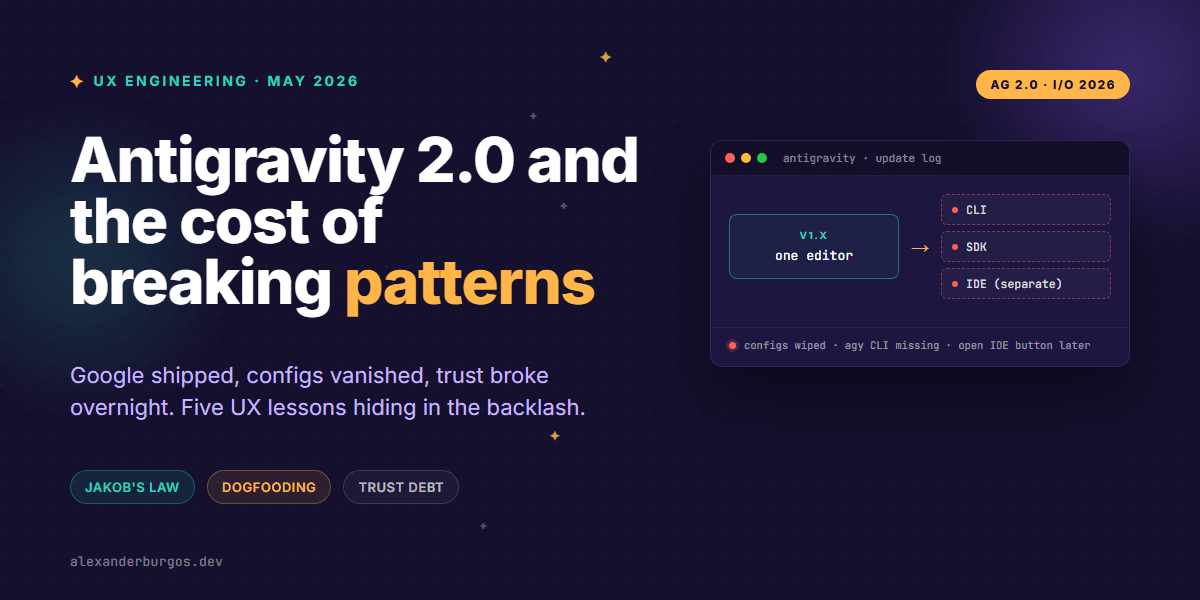
On 19 May 2026, thousands of developers opened their laptops to find their tools missing. Terminals had vanished. File explorers were gone. Configurations and extensions were silently wiped. The editor they had been writing code in the night before now refused to load, because Google had auto-pushed Antigravity 2.0 in the background during the I/O 2026 keynote.
Antigravity is Google's agentic dev platform, the one Varun Mohan has been leading since the Windsurf acquisition. Version 2.0 is the team's bet on an agent-first future, where the IDE becomes one surface among several alongside a CLI and an SDK. That is a defensible product direction. The problem is not where the team wants to go. The problem is the speed and the bluntness with which they tried to get there.
What actually broke
The damage was specific and avoidable. Within hours of the auto-update, the Antigravity subreddit and the Google AI Developers forum filled with the same complaints repeated by different people.
- The integrated editor was removed and split into three pieces: a separate IDE, a CLI, and an SDK
- Configurations and extensions were wiped without any auto-import path
- The old version saved data in one folder, the new version read from a different folder
- Antigravity 2.0 and the standalone Antigravity IDE fought over the same install directory, with one deleting the other
- The new
agyCLI, announced as the replacement for the deprecated Gemini CLI, was not available on any public package manager for two days after launch
One developer summed it up with a sentence I keep thinking about: "it reeks of non-technical people shipping code to production". Another called the agent-first pivot a "massive step backward". The reactions were not about the new direction. They were about the cost of getting there.
The five UX principles Antigravity 2.0 broke
You can frame the backlash through five fairly old UX principles. None of them are exotic. All of them were on display.
1. Jakob's Law: people expect your product to work like the others
Jakob Nielsen's old observation is that users spend most of their time on other products, so the familiar pattern is the safe one. An IDE has integrated editing. That has been true for thirty years across every dev tool on every platform. The moment Antigravity 2.0 stripped that out and made the IDE a separate install, the team broke the contract every developer was holding. It does not matter if the new flow is theoretically better. The cost of relearning is real, and the team made every user pay it on the same Tuesday morning.
2. Loss aversion: configs are not files, they are identity
Loss aversion is the finding that losses hurt about twice as much as equivalent gains feel good. A developer's editor configuration is not a list of preferences. It is years of muscle memory: the keybindings, the colour theme, the snippets, the extensions, the workspace layout. Wiping that without warning is not a quality-of-life issue. It is taking away something the user feels they owned. Even if the new defaults are better, the loss lands first.
3. The forced migration tax
If you change a platform, you owe your users the migration. Antigravity 2.0 pushed the change and shipped the migration two days later. The agy CLI was not on any package manager when it was announced. Old folders and new folders did not agree. The platform was, in effect, asking users to do the integration work the team had not finished. The unstated message was "figure it out", which is the worst message a tool can send.
4. The dogfooding signal
During the I/O 2026 demo, sharp viewers spotted a folder on the presenter's machine called Codex, after a competing product. That detail spread fast. It is a tiny thing on paper. In practice it answered a question users always quietly ask: does the team that made this tool actually use it? When the visible answer is "not for the demo", every other concern stops being a hunch and starts being evidence.
5. Trust debt compounds
Trust is the most expensive currency a developer tool has, and it is the slowest to earn back. The Antigravity team did not lose users on the new architecture. They lost them on the experience of opening their laptop and finding their work environment missing. Once that has happened once, every future update is going to be opened with a held breath.
How Google tried to claw it back
Credit where it is due: the response was fast. By 23 May, Varun Mohan had acknowledged the team "never intended to remove IDE support" and conceded they "should have been clearer from the start". A new patch shipped a visible "Open IDE" button on the web dashboard, an "Install IDE" prompt for users without the standalone editor, and a one-click migration tool that restored settings, extensions and keybindings from the old install. Windows-specific IDE crashes were resolved the same day. Google also wiped the weekly Gemini usage quota for everyone as an apology gesture. All of that is good. None of that prevents the trust debt that was created on the first day.
What you can do differently
Most of us are not shipping IDEs to a million developers on a Tuesday morning. We are shipping smaller things, more often. The same principles still apply at any scale.
- Treat user configuration as user property — never delete it, always offer an import path before the new version runs
- Ship the migration before the redesign, not after, even if it means delaying the announcement
- Make the old patterns available alongside the new ones for at least one release cycle, so users can choose when to switch
- Be honest with users about what is breaking. A short release note that says "this update splits the editor into three pieces and your settings will need to be migrated" turns a betrayal into a heads-up
- Make sure your team is visibly using the new version before you ship it. If a demo shows a competitor's folder on screen, no patch notes are going to fix the optics
Wrapping Up
Antigravity 2.0 is a useful case study in why design decisions are political. The team had a perfectly defensible product vision. The execution forced thousands of people to deal with a problem at the wrong time, in the wrong way, and without warning. The cost of that decision will outlast every patch they ship to fix it.
- A familiar pattern is a contract with your users, not a constraint on your roadmap
- The migration is part of the feature, not a follow-up ticket
- Trust is fast to lose and slow to earn back, so design for the worst day, not the demo day
Try this on your next redesign: write the release note before you build the feature. If the note sounds like a betrayal, the feature is not ready to ship.
If you want to go deeper and learn how to build real, production-ready CSS design systems step by step, check out my full course here: CSS Design Systems Course.
Found this useful? I share more patterns like this on Twitter at https://x.com/alexandersstudi and LinkedIn at https://www.linkedin.com/in/alexandersstudio/.